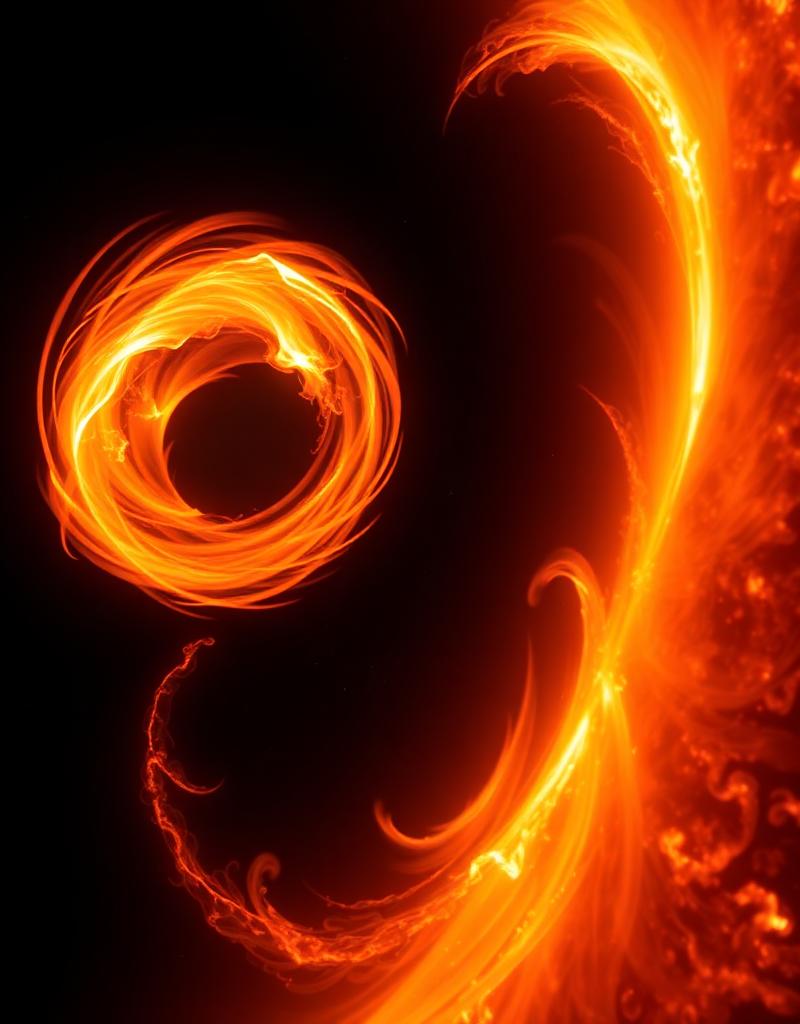
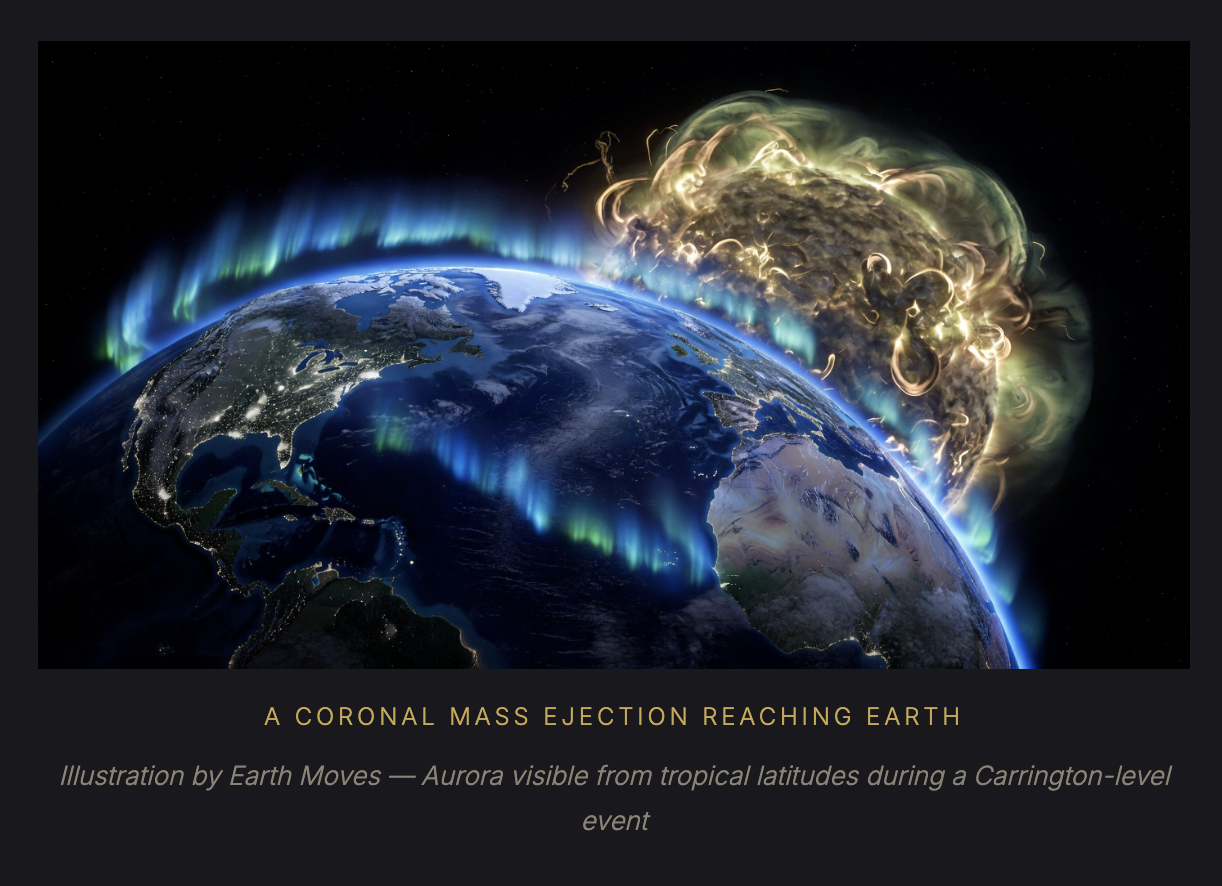
Our life-giving Sun is continuously sending exploding bursts of particles into space. These solar flares hit Earth from time to time. The Carrington Event of 1859 was the most powerful geomagnetic storm ever recorded — and it fried telegraph lines, started fires in telegraph offices, and produced auroras visible from the tropics.
What a Carrington Event Would Do Today
A Carrington-scale solar storm hitting Earth today, with a vastly denser shell of satellites in orbit, could trigger a cascade of infrastructure failures unlike anything modern civilization has experienced. Power grids, particularly those at higher latitudes, would be vulnerable to geomagnetically induced currents capable of burning out large high-voltage transformers — components that take months to over a year to replace and are not mass-manufactured.
With internet backbone links, data centers, and cellular networks dependent on a stable grid and precise timing, large regions could lose communications for extended periods. GPS would be degraded or lost entirely. Financial systems that rely on precise atomic clock synchronization could be disrupted. The economic cost has been estimated in the trillions.
With near-future plans for data centers in space, a Carrington event may be the most massive economic natural catastrophe ever to strike our civilization.
Reliving 1859
Richard Carrington peered through his Kew Observatory refractor on 1 September 1859. He observed a white-light complex of sunspot groups when suddenly two brilliant beads of white light appeared and moved rapidly across the sunspot region before fading after about five minutes. Within 17 hours, Earth's magnetometers went off the scale.
Auroras were observed as far south as 18°N in Hawaii and Colombia. Skies glowed "bright as day" from the Caribbean to Queensland. Telegraph operators reported that their equipment was sparking and catching fire — and some reportedly continued sending and receiving messages even with their batteries disconnected, powered entirely by the induced currents from the storm.
Why Another One Is Inevitable
Solar cycles of flare activity reach maximum every 11 years. We are currently in an active cycle. A Carrington-level ejection happens quite often on the Sun — but it also needs to hit Earth directly, and Earth is a small target. Luckily we now monitor solar space weather with the SOHO and SDO projects. Their coronagraphs can spot coronal mass ejections heading toward Earth, giving us approximately 12–72 hours of warning.
What to Do If an Alert Goes Off
If a Carrington-level warning is issued and you have 12 hours to prepare: charge all devices and power banks immediately. Fill water containers in case pumping infrastructure fails. Turn off and unplug non-essential electronics. Keep at least one battery or hand-crank radio ready. Prepare as you would for an extreme weather event.
Tracking with the Earth Moves Digital Watch
The digital Earth Moves Watch receives NOAA Space Weather Prediction Center feeds. On the watch face, we show solar activity as a burst from the Sun. We can show the probability of aurora as a cloudy light on the Earth display. If and when a Carrington-level ejection heads toward Earth, our watch will show that graphically and as a warning — giving you the information you need, worn on your wrist.