Space Exploration6 min read
The Moon as a Stepping-Stone for Humankind
An essay on why our nearest neighbor is about to become our most important continent.
By Brage W. Johansen
An essay on why our nearest neighbor is about to become our most important continent.
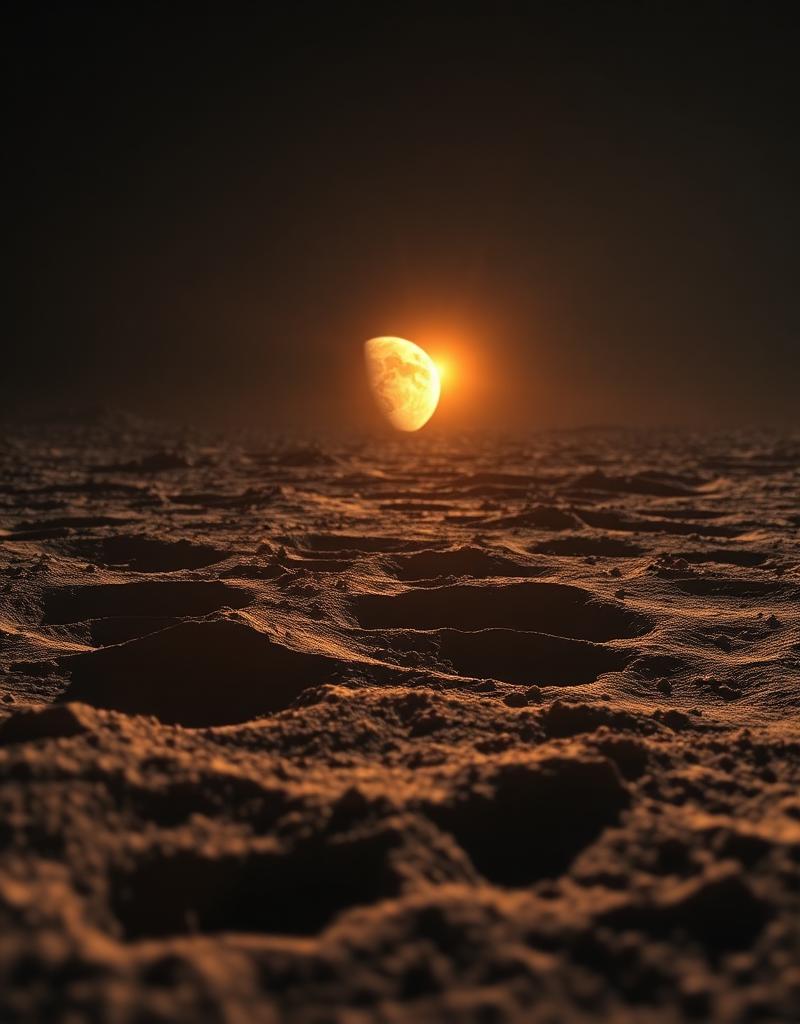
Look up at the Moon tonight. That gray, dignified companion has been hanging in our sky for four billion years, and for the last billion years, it has shaped and watched life evolving on Earth. Now, for the second time in history, we humans are about to go there again — not as visitors, but as settlers. The Moon is not the final destination. The Moon is the loading dock for the rest of the universe.
The new lunar race is, on its surface, a contest of flags. The United States, through Artemis, intends to return astronauts to the lunar south pole and stay. China, through Chang'e and the planned International Lunar Research Station, intends to do the same. But beneath the flags is something far more interesting than national pride. There is real estate. There is exploration with a business plan. There is water ice in permanently shadowed craters, the kind you can crack into hydrogen and oxygen and call rocket fuel. There are multiple sites with lavatubes and mineral sites that are unexplored and can have great value. Whoever lands first does not just plant a banner; they are grabbing land and setting standards for how a lunar world should look. That is why the race matters, and that is why it is accelerating.
Consider the data center. Down here on Earth, we are pouring rivers through cooling towers and lighting up power grids just to keep our digital world running. The Moon offers something remarkable: a stable, airless environment with extreme cold in permanently shadowed regions, abundant solar power on its sunlit peaks, and distance from Earth's increasingly crowded electromagnetic spectrum. A lunar data center would be harder to reach, yes — but it would be nearly impossible to physically seize, naturally cooled, and powered by sunlight that never sets on the southern peaks.
Now, the rocks. The Moon is, geologically speaking, a slice of early Earth that never got recycled. Its regolith is rich in oxygen — locked into oxides, but extractable. It contains silicon, aluminum, iron, titanium. With the right equipment, you could 3D-print a habitat, smelt structural components, and manufacture basic tools without shipping a gram from Earth. The Moon is not just a destination; it is a parts supplier for deep space.
There is also the matter of survival. The dinosaurs did not have a space program; we do, and we should use it. A permanent lunar base extends the range of our telescopes, improves our ability to detect incoming asteroids, and — critically — provides humanity with a second location. If something catastrophic happens to Earth, the species does not end. Life finds a way; we should help it.
Finally, the economics. Let's talk about ordinary rocket fuel. Getting a kilogram of payload off Earth costs thousands of dollars. Getting that same kilogram off the Moon costs a fraction — the gravity is one-sixth, and there is no atmosphere to fight through. If you can manufacture fuel on the Moon from local water ice, you have a refueling station at the top of Earth's gravity well. Every mission beyond the Moon becomes dramatically cheaper. Mars, the asteroid belt, the outer planets — all become more accessible from a fueled lunar depot than from Earth's surface directly.
So when you look up tonight, do not see just the man in the Moon. See a new continent — our 8th continent, the steppingstone to the universe.
Wear cosmos on your wrist. Get used to knowing where our 8th continent, the Moon, is.