Philosophy of Time5 min read
We Broke Time. Here's How to Fix It.
Has the industrial 2×12 hour timekeeping led us away from nature and astronomy?
By Brage W. Johansen
Has the industrial 2×12 hour timekeeping led us away from nature and astronomy?
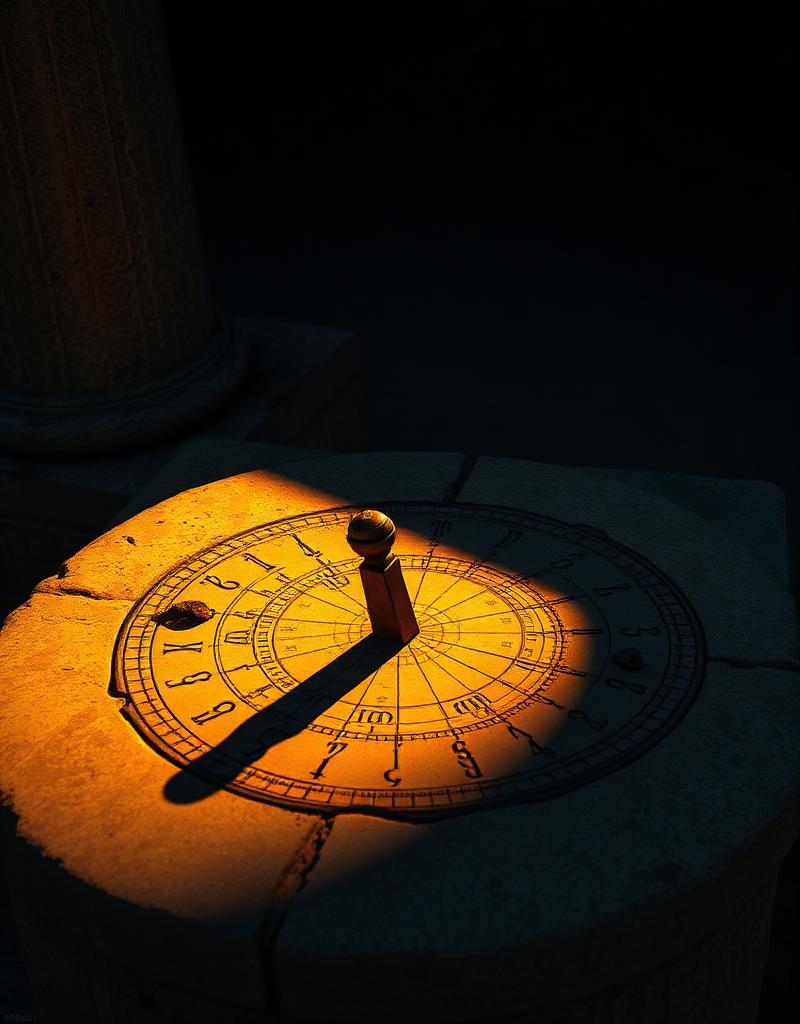
Some thousands years ago, an Egyptian engineer planted a stick in the ground, watched its shadow crawl across marked stones, and humanity had its first clock. Not a bad start for a species that had only recently figured out agriculture. The sundial was a profound instrument — a conversation between Earth, Sun, and human civilization. It didn't impose time, it followed it.
That relationship — intimate, astronomical, honest — lasted for millennia. Then we industrialized it into oblivion. But let's not get ahead of ourselves.
Before the sundial, there were the megaliths. Stonehenge. Newgrange. Mnajdra in Malta. These were not primitive rock piles. They were precision instruments, calibrated to the solstices, equinoxes, and the turning of the year. The people who built them knew where the Sun rose on the longest day, when Sirius unlocked a new year, and they built their world around that knowledge.
Meanwhile, in the jungles of Mesoamerica, the Maya were doing something that should embarrass modern calendar makers. Their Long Count calendar tracked time across thousands of years with an accuracy that still astonishes astronomers. They weren't measuring seconds. They were reading the sky.
And when the Sun went down? The ancients didn't go blind to time — they went stellar. The night sky was divided into twelve sections by the Egyptians, each marked by a rising star group. Time was literally written in starlight.
It was the Egyptians and Babylonians who handed us the numbers we still use today. Egypt gave us the 24-hour day — twelve hours of daylight, twelve of night. Babylon gave us the 60-minute hour, inherited from their base-60 mathematical system. These systems were still, fundamentally, astronomical. The hour was defined by the Sun's arc. The day was defined by Earth's rotation.
Here is a fact that will rewire your brain: only two hundred years ago, there were approximately one million different times in use across the Earth. Every town kept its own local solar time, set by its own sundial. Bristol was ten minutes behind London. New York was five minutes ahead of Philadelphia. No one particularly cared, because no one could travel faster than information anyway.
Then came the railways. Then came the telegraph.
Suddenly, for the first time in human history, you could travel faster than information had previously moved, and you could communicate instantly across vast distances. One million timezones became an administrative catastrophe. Trains ran late. Schedules were impossible. So, in an act of magnificent bureaucratic violence, the world standardized. Twenty-four zones of one time each. The sun's position over your head? Irrelevant.
It was a triumph of human coordination. It was also the moment we lost, with surgical precision, the link between human time and astronomical time.
We locked in two sets of 12-hour watches — AfterMidnight and PastMidday — a direct inheritance from Egypt, preserved across millennia. And here is the philosophical splinter that should lodge permanently in your mind: there is nothing in nature that takes exactly one second. The second is defined by the vibration of cesium atoms — a definition chosen to match the old mechanical second as closely as possible. The minute is 60 of those. The hour is 60 of those. The day is 24 of those. All of it is a human decision, compounding upward from an arbitrary anchor.
We built a clock for machines and called it reality.
This is the question that puts everything in a new light. We need industrial time — of course we do. Without it, there are no trains, no surgeries, no satellites, no video meetings. But what if a watch could carry both? What if your wrist could tell you it is 14:37 — and also tell you where the Sun currently sits in the sky, where the Moon is in its orbit, whether the tides are rising or falling?
This is the premise of the Earth Moves watch. Not a rejection of industrial time, but a reunion with the sky it came from. A reminder, worn on the wrist, that before the second was defined and the timezone was drawn, there was a planet rotating under a star, and everything we ever called time was just our attempt to describe that.
Because here is the deepest truth about time: we did not discover seconds and minutes. We decided them. And when we decided them we were blinded by the wonders of mechanic, machines and industrial efficiency. Nature was not valued. Surprisingly astronomy was not either. Modern man deserves a concept of time that connects nature, space and people with a longer and less stressed rhythm.
The Earth Moves. Do you take the challenge to develop your mind? It's about time.