Astronomy4 min read
A Lunar Eclipse — All Sunrises and Sunsets Projected on the Moon
A lunar eclipse is one of the most elegant demonstrations of geometry in the local universe, and it's completely free.
By Brage W. Johansen
A lunar eclipse is one of the most elegant demonstrations of geometry in the local universe, and it's completely free.
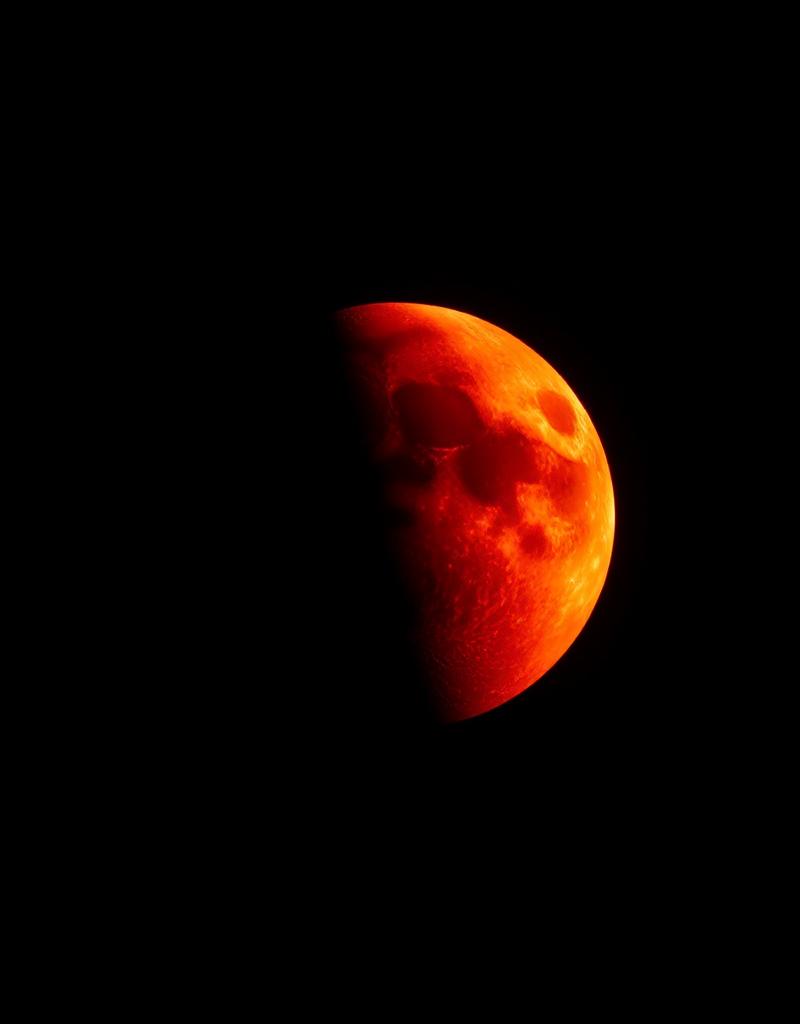
A lunar eclipse is one of the most elegant demonstrations of geometry in the local universe, and it's completely free. It occurs when Earth positions itself directly between the Sun and the Moon, casting its shadow across the lunar surface. Unlike a solar eclipse, which demands you stand in a very specific path of geography, a lunar eclipse is visible from anywhere on Earth where the Moon is above the horizon. Half the planet gets front-row seats.
There are three varieties: a penumbral eclipse, where the Moon grazes Earth's faint outer shadow (subtle enough that most people shrug and go back to bed); a partial eclipse, where only a portion of the Moon enters the dark umbral shadow; and a total lunar eclipse — the main event.
With twelve full moons each year, you'd be forgiven for expecting a lunar eclipse at every one of them. The reason it doesn't: the Moon's orbit is tilted about five degrees relative to Earth's orbital plane around the Sun. Most full moons pass slightly above or below Earth's shadow entirely. Only when the geometry aligns precisely — Moon at full phase, crossing the ecliptic plane near a node — do we get an eclipse.
When the Moon slides fully into Earth's shadow, it doesn't go dark — it turns a deep, rusty red. The culprit is Earth's atmosphere. Sunlight bending around the edges of our planet is filtered through hundreds of kilometers of air, stripping out the blue wavelengths and leaving only the reds and oranges. What you're seeing, projected onto the Moon, is the light of every sunrise and every sunset happening simultaneously around the entire circumference of Earth. It is, in a sense, the most poetic thing the solar system regularly does.
Columbus, 1504 — Jamaica. Stranded on Jamaica with a mutinous crew and dwindling goodwill from the locals, Columbus consulted his almanac. A total lunar eclipse was coming. He warned the indigenous Arawak people that his God would show displeasure by turning the Moon blood red. When it happened exactly as predicted, he was resupplied immediately. His knowledge of celestial mechanics saved his life.
Constantinople, 1453. As Ottoman forces closed in on the Byzantine capital, a blood moon appeared over the city — widely interpreted as a sign that God had abandoned Constantinople. The city fell shortly after, ending the Byzantine Empire. The eclipse did not cause the fall, but it destroyed morale at the critical moment.
The Great American Blood Moon, 2018. Technically a "Super Blue Blood Moon," this eclipse was the first total lunar eclipse visible from North America in over three years — and it coincided with the Moon being at its closest point to Earth, making it appear larger and brighter than usual. Millions watched live streams; the hashtag trended globally. The cosmos, performing for an audience of billions, with no CGI required.
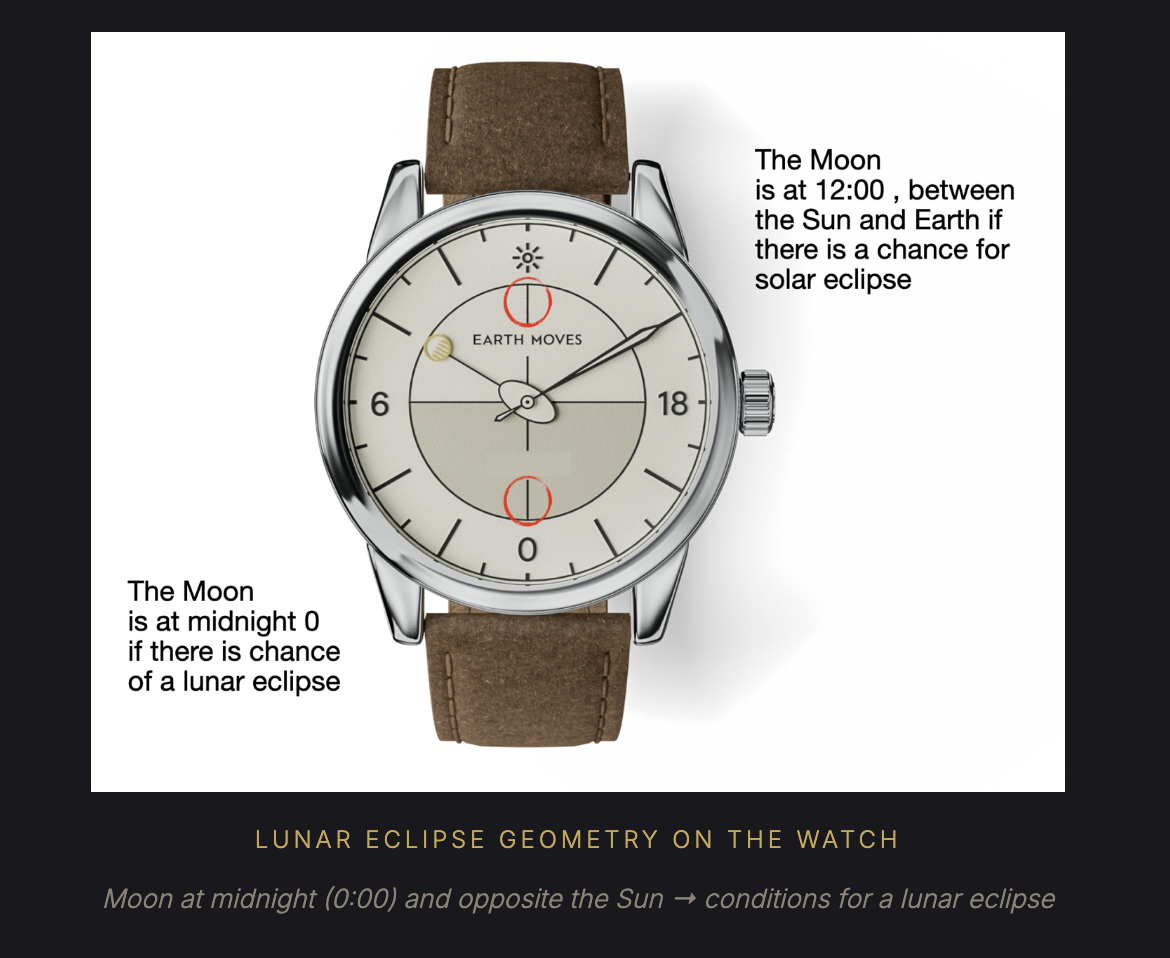
Not everyone can stay up until 3 a.m. waiting for an eclipse, but the Earth Moves watch brings the geometry to your wrist. When the Moon marker on your watch face aligns opposite the Sun position — that is the geometry of a potential lunar eclipse. The three-body alignment made visible, always with you.
Lunar eclipses are a reminder that the cosmos runs on geometry, not magic — though from the ground, it's genuinely hard to tell the difference.