Astronomy5 min read
Solar Eclipses: The Main Event You Have to Experience
A solar eclipse is the solar system showing off — a glimpse into cosmos you have to experience in person.
By Brage W. Johansen
A solar eclipse is the solar system showing off — a glimpse into cosmos you have to experience in person.
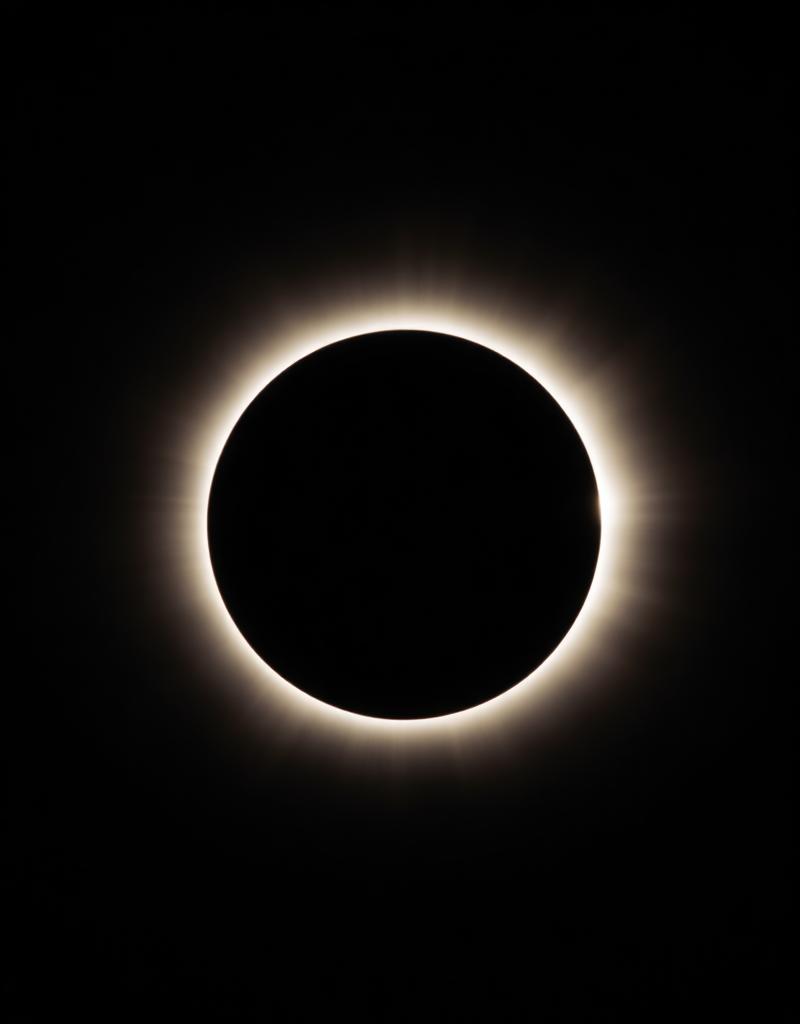
A solar eclipse is the solar system showing off and provides a glimpse into cosmos. It occurs when the Moon passes directly between Earth and the Sun, casting its shadow upon a narrow strip of our planet's surface. The coincidence required to make this work is almost offensive: the Sun is roughly 400 times wider than the Moon, and also roughly 400 times farther away. The result is that both objects appear almost exactly the same size in our sky. For a brief window, the Moon fits over the Sun like a lid, and the laws of physics deliver something that looks unmistakably like art.
There are three types. An annular eclipse occurs when the Moon is slightly farther from Earth in its elliptical orbit, leaving a glowing ring — the "ring of fire" — visible around its edges. A partial eclipse means the alignment is off-center, and the Sun appears bitten. And then there is the total solar eclipse: the only one that truly matters.
Nothing in ordinary life prepares you for totality. In the minutes before, the light takes on a strange, bruised quality — not dimmer exactly, but wrong, as though the world is running on emergency power. The temperature drops. Birds go quiet. Shadows sharpen to an unusual crispness.
Then the last sliver of Sun is extinguished. And day becomes night.
The stars come out. Venus is suddenly visible. Around the black disc of the Moon blooms the solar corona — the Sun's outer atmosphere, normally invisible against its normal brightness, now revealed as a shimmering, asymmetric halo flaming around the Moon. It is otherworldly. People freeze. People forget to take photographs.
Totality lasts, at most, around seven and a half minutes. Most total eclipses deliver two to four minutes. When the Sun returns, there is a collective exhale across the entire path of totality, and you miss the phenomenon instantly, you want to see more of the magic of the universe.
Thales of Miletus, 585 BC. The Greek philosopher predicted a solar eclipse with enough accuracy that when it occurred during a battle between the Lydians and the Medes, both sides interpreted it as a divine sign to stop fighting. The war ended. The eclipse that ended a war. History's most productive astronomical prediction.
Frankish Kingdom, 5th May 840 AD. The solar eclipse went over today's France and northern Italy and made such a strong impression on Emperor Louis the Pious that he is said to have been so frightened he stopped eating and died shortly after. It hastened the fragmentation of the Carolingian Empire.
Arthur Eddington, 1919 — Island of Príncipe. When the Moon blocked the Sun off the coast of West Africa, Eddington photographed the stars near the solar edge. The stars appeared shifted from their known positions — exactly as Einstein's General Theory of Relativity predicted they would be, due to the Sun's gravity bending light. The eclipse confirmed relativity and made Einstein world-famous overnight.
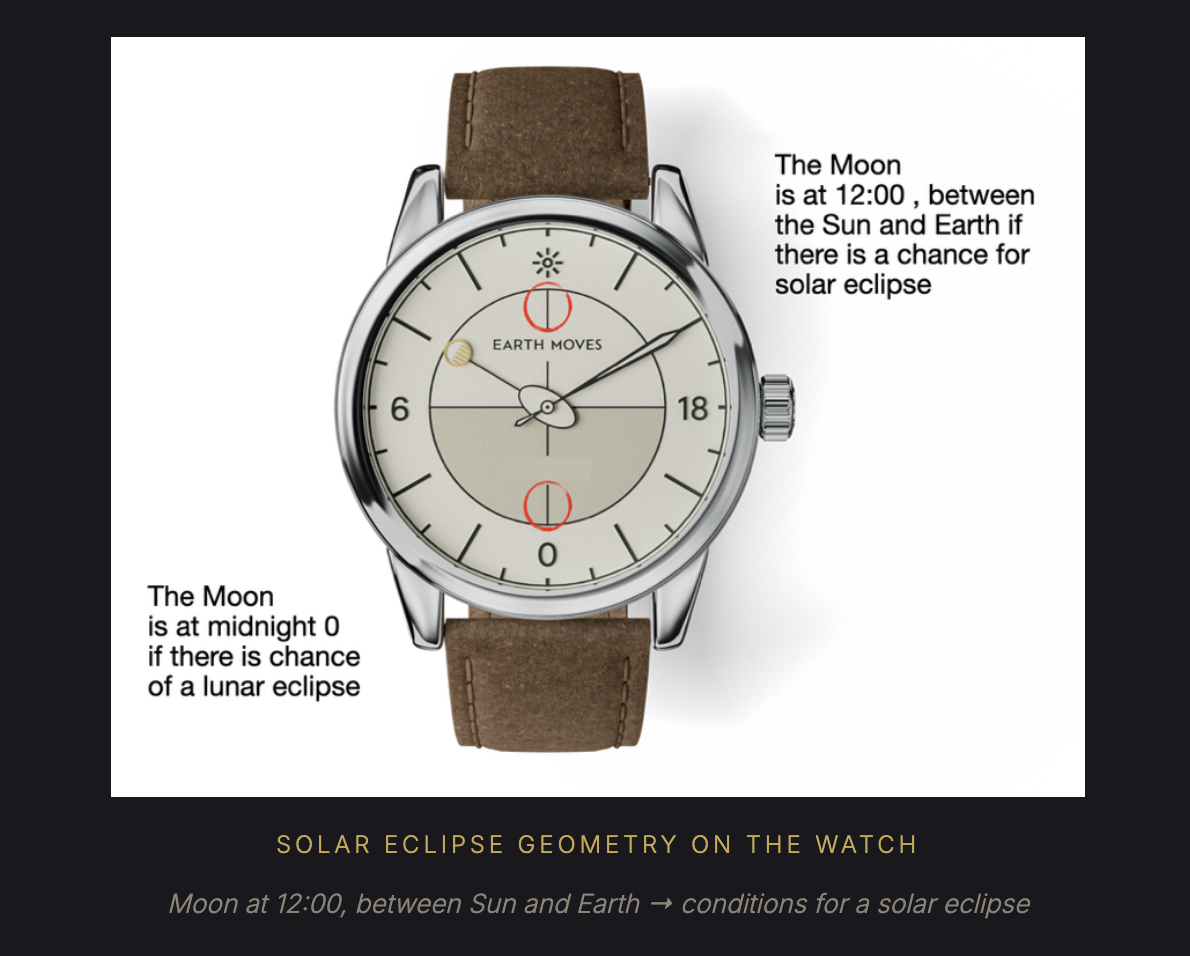
A solar eclipse requires two things: knowing when to look, and knowing where to be. The Earth Moves watch shows the Sun–Earth–Moon geometry continuously. When your watch shows the Moon marker approaching the Sun marker, you are watching the same orbital mechanics that produces a solar eclipse — playing out in slow motion, all day, every day, on your wrist.
If you ever find yourself standing in the path of totality, stay. The shadow will find you. And for 3–4 minutes, you will understand, in your bones, that you are standing on a rotating planet, in orbit around a star, accompanied by a moon that has absolutely no business being the exact same apparent size as the Sun — and yet here we are.